.avif)
Unlock Your Credit Potential: Why Paying Down to 9% is the Secret to Success
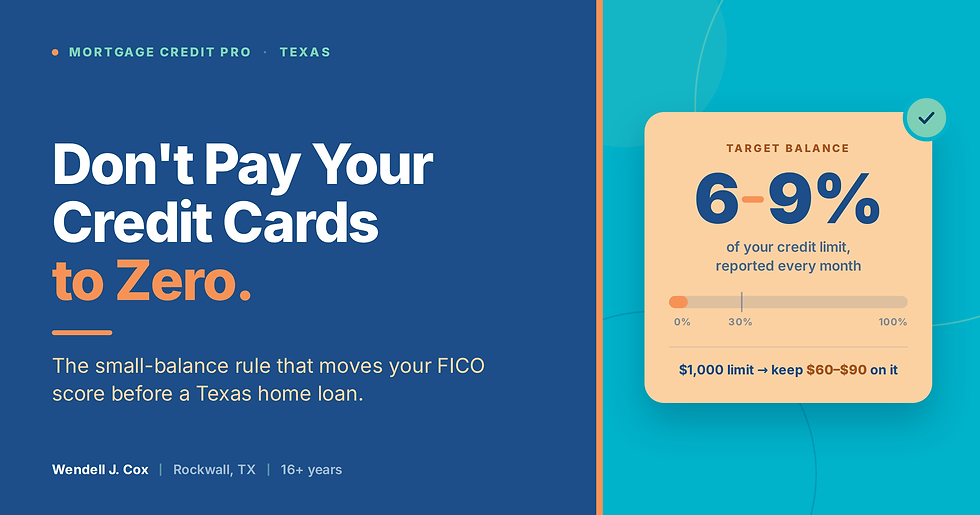
You have probably heard the common advice to keep your credit card balances below 30% of your credit limit. It sounds reasonable, right? But what if I told you that paying down your balances to just 30% is actually holding you back from boosting your credit score faster? The real game changer is paying your credit cards down to 9% of your credit limit. This simple adjustment can make a huge difference in your credit repair journey and help you qualify for a mortgage sooner.
My name is Wendell Cox, and I’m a mortgage credit professional. I work with clients every day to improve their credit so they can buy their dream homes. This tip is the number one piece of advice I share repeatedly because it works. Let me explain why paying down to 9% matters and how you can use this strategy to unlock your credit potential.

Why 30% Is Not Enough
The 30% credit utilization rule has been around for years, and many people still follow it without question. Credit utilization is the ratio of your credit card balances to your credit limits. For example, if your credit limit is $1,000, keeping your balance below $300 fits the 30% rule.
While 30% is better than maxing out your cards, it is not the ideal target if you want to see quick improvements in your credit score. Credit scoring models reward lower utilization rates because they show you are managing your credit responsibly and not relying heavily on borrowed money.
When you keep your balances at or below 9%, you send a stronger signal to lenders and credit bureaus that you are in control of your finances. This can lead to faster credit repair results and better mortgage credit options.
How Paying Down to 9% Works
Let’s break down what paying down to 9% looks like in practice. Suppose you have a credit card with a $300 limit. Instead of paying it down to $90 (30%), you want to reduce the balance to about $20 or less.
Here’s why this matters:
Lower utilization improves your credit score: Credit scoring models like FICO and VantageScore consider utilization as a major factor. The lower your utilization, the better your score.
Shows responsible credit behavior: Keeping a small balance shows you use credit but don’t depend on it.
Helps with mortgage credit approval: Lenders look closely at your credit utilization when deciding if you qualify for a mortgage. Lower balances improve your chances.
If you have multiple credit cards, apply this rule to each one. For example, if you have three cards with limits of $500, $1,000, and $2,000, aim to keep balances around $45, $90, and $180 respectively.
Practical Tips to Maintain 9% Utilization
Keeping your credit card balances low can feel challenging, but these tips can help:
Make multiple payments each month: Instead of waiting for your statement, pay down your balance several times to keep utilization low.
Set alerts for your balances: Many credit card apps let you set notifications when your balance reaches a certain amount.
Use credit cards for small purchases only: Avoid large expenses on your cards if you want to keep utilization low.
Increase your credit limits: Requesting a higher credit limit can lower your utilization ratio if your spending stays the same.
Monitor your credit reports regularly: Check your credit reports to ensure your balances are reported accurately.
These steps support your credit repair efforts and help you maintain a strong credit profile for mortgage credit approval.
Why This Matters for First-Time Home Buyers
If you are a first-time home buyer, your credit score can make or break your ability to get a mortgage. Many people don’t realize how much credit card balances impact their mortgage credit eligibility.
By paying down your credit cards to 9%, you can:
Improve your credit score faster: This means better interest rates and loan terms.
Show lenders you are financially responsible: Lower utilization signals less risk.
Increase your chances of mortgage approval: Lenders prefer borrowers with low credit utilization.
This strategy is especially useful if you are working with a credit repair USA company or mortgage credit professional. It’s a simple, actionable step that can speed up your path to homeownership.
Final Thoughts and Next Steps
The myth of paying your credit cards down to 30% is widespread, but it is not the best advice if you want to boost your credit quickly. Paying down to 9% of your credit limit is a proven strategy that helps you improve your credit score faster and strengthens your mortgage credit profile.
If you want personalized help with credit repair or mortgage credit, consider reaching out for a free consultation. At Connect.MortgageCreditPro.com, we specialize in helping clients improve their credit so they can buy homes with confidence.
Start today by reviewing your credit card balances and making a plan to reduce them to 9%. This small change can unlock your credit potential and bring you closer to your homeownership goals.

Comments