.avif)
What Credit Score Do I Need to Buy a House?

By a former mortgage lender and credit restoration specialist
If you've ever Googled this question, you've probably seen answers ranging from 500 to 680 and everything in between. That range is confusing — and for good reason. The truth is more nuanced than any single number, and after seven years as a mortgage lender closing FHA, conventional, VA, and USDA loans, I can tell you that the credit score is just the beginning of the story.
Let me break this down the way I would for a client sitting across from me.
The Real Numbers You Need to Know
Here's the honest answer most people never get:
580 — You can buy a home at this score, but you'll need a down payment of 3.5% to 10% out of pocket. For most first-time buyers, that's a significant barrier.
620 — This is the magic number. At 620, you open the door to down payment assistance programs based on your income and the area where you want to live. That can mean buying a home with little to nothing out of pocket.
So if you're sitting at a 595 right now, the question isn't "can I buy a house?" It's "is it worth being patient a little longer to get to 620 so that someone else helps with my down payment?" In most cases, the answer is yes.
But Here's What Nobody Tells You: The Score Isn't Everything
This is the part that trips up buyers and even some lenders.
When you apply for a mortgage, your application goes through an Automated Underwriting System (AUS). This system doesn't just look at your credit score. It reads your entire credit report and evaluates whether you have what I call a lendable credit profile.
I've had lenders call me completely stumped, asking why a client with a 642 credit score can't get a loan approval. The answer? An incomplete credit profile. The score was there. The profile wasn't.
With targeted credit restoration, I was able to get that same client approved quicklysimply by filling in the missing pieces the AUS needed to see.
What a Lendable Credit Profile Actually Looks Like
Think of your credit profile as a checklist the underwriting system is running through. Here's what it typically wants to see:
3 to 4 credit cards on your report (revolving credit)
At least one installment loan (car loan, personal loan, student loan) to complete your credit mix
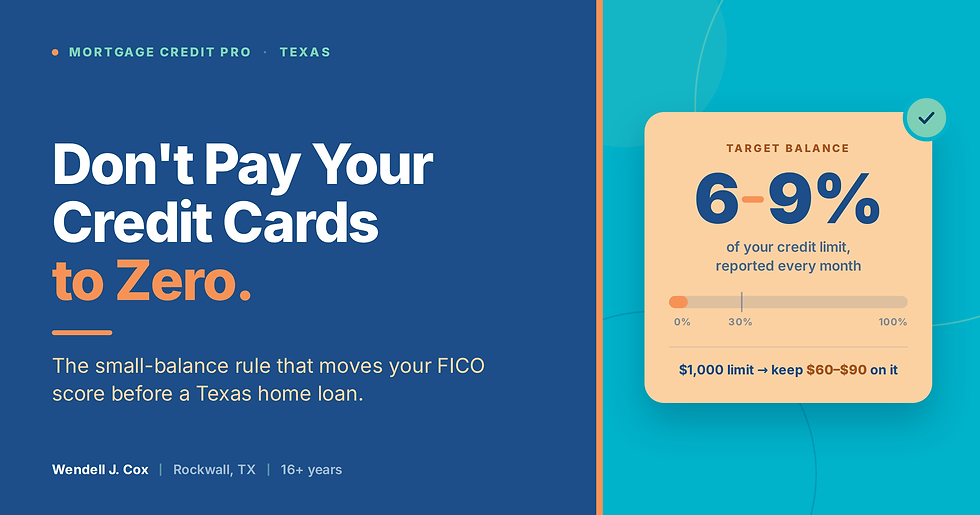
Low credit utilization — ideally under 30% across your cards
Clean payment history for at least the past 6 months
No collections — or as few as possible
A co-borrower with a score in the 620–660 range, if possible, to strengthen the application
Missing even one of these components can cause an AUS denial even when the score looks fine on paper. This is exactly why working with someone who understands both credit and mortgage lending matters.
A Real Client Story: From 560 to Homeowner in 4 Months
This past week, a client of mine closed on his home. When we first connected, his credit score was at 560 not enough to qualify, and certainly not enough to access down payment assistance.
Over four months, we worked systematically to improve his credit profile. We disputed inaccuracies, built up the right accounts, and got his score to approximately 660.
But we didn't stop at the credit score.
When I reviewed his full financial picture, I noticed his car payment was $1,300 a month a serious problem for his debt-to-income ratio (DTI), which is the percentage of your monthly income that goes toward debt payments. A high DTI is just as dangerous as a low credit score when it comes to loan approval.
I advised him to refinance his car through a credit union, which brought his payment down to $800 a month. That $500 difference was the breathing room his DTI needed.
The result? A closed loan and keys in his hand.
The Debt-to-Income Ratio: The Silent Dealbreaker
Most people focus entirely on the credit score and forget about DTI. Lenders want to see your total monthly debt payments (including the new mortgage) stay within acceptable limits relative to your gross income.
If your car payment, student loans, credit cards, and future mortgage payment eat up too much of your income, you can be denied even with a great credit score.
Before you apply for a mortgage, take an honest look at your monthly debt obligations. Could refinancing a car loan or paying down a credit card make a difference? Often, it can.
Which Loan Type Is Right for You?
Not all mortgages are created equal, especially when you're working with a lower credit score or limited savings.
FHA Loans — Backed by the Federal Housing Administration. More flexible on credit scores and DTI. Great for first-time buyers. Requires mortgage insurance.
VA Loans — For veterans and active military. Arguably the best loan product available: no down payment required, no private mortgage insurance, and flexible qualification standards.
Conventional Loans — Generally require a higher credit score, more savings, and a stronger overall profile. Often not the right starting point for someone rebuilding credit.
USDA Loans — Available in eligible rural and suburban areas (outside large metro areas). Can offer 100% financing, but DTI requirements are stricter and geographic restrictions apply.
If you're starting your credit journey, FHA and VA loans are typically the most accessible. Don't let anyone push you toward conventional financing before you're ready.
Don't Trust Credit Karma for Mortgage Decisions
This is critical: Credit Karma does not show you your mortgage credit score.
Credit Karma uses a scoring model called VantageScore. Lenders use FICO scores specifically older versions like FICO 2, 4, and 5 to make mortgage decisions. These scores can differ significantly from what you see on Credit Karma. On top of that, Credit Karma only shows two of the three credit bureaus.
If you want an accurate picture of where you stand for a home loan, use:
SmartCredit.com — Shows all three bureaus with detailed data you can actually work with
MyFICO.com — Shows your actual mortgage scores, the ones lenders pull
Checking Credit Karma and assuming you're ready for a mortgage is one of the most common and costly mistakes buyers make.
Can You Do Credit Repair Yourself?
Yes — and no.
You can dispute errors on your own, open new accounts, and work to pay down balances. The information is out there. But here's the reality: most people find the process overwhelming, confusing, and slow. Without a clear strategy, it's easy to make moves that hurt your score instead of helping it.
Working with a mortgage-focused credit restoration company one that understands what lenders need to see — shortens the timeline and reduces costly mistakes. A good credit restoration partner doesn't just delete negatives. They build a complete, lendable profile in a systemized way that compounds on itself.
What to watch out for: Avoid any company that promises deletions in a guaranteed timeframe, offers a "90-day flat fee" turnaround, or uses what's known as a "credit sweep" a scheme involving fraudulent police reports and fake FTC identity theft complaints. These are illegal and can cause serious legal and financial harm.
Look for a company that talks about building your profile, not just erasing your past.
How Long Does It Really Take?
If you're starting from bad credit or recovering from a difficult financial period, be realistic: 6 to 12 months is a reasonable timeframe for meaningful improvement.
That might feel discouraging, but think of it this way — the time is going to pass anyway. The question is whether you'll spend it building toward homeownership or standing still.
During that time, here's what you should be doing:
Get on the right credit monitoring platform (SmartCredit or MyFICO)
Open or optimize credit card accounts to hit the 3–4 card threshold
Check your installment loan situation
Keep utilization low and make every payment on time
Avoid new collections at all costs
Work on your DTI — can you reduce any monthly debt obligations?
If You Feel Hopeless, Read This
I've been where you are.
As a single parent, I went through my own hard financial times. Bad credit doesn't feel like a temporary problem — it feels like a permanent label. I know that feeling firsthand.
But I also know that with the right plan and consistent effort, homeownership is achievable. I've helped clients across the credit spectrum get to the closing table. I've seen 560s become 660s. I've seen people who were told "no" by three lenders close on a home four months later.
It is not a forever label.
Your Next Step
If you're not sure where you stand, the best thing you can do is get an accurate picture of your credit — all three bureaus, with your actual mortgage scores.
We offer a free credit consultation for anyone who wants to understand what it would take to get them into a home. No pressure, no judgment. Just an honest look at where you are and a clear plan for getting where you want to be.
You deserve to own a home. Let's build the path to get you there.
The author is a former mortgage lender with seven years of experience closing FHA, conventional, VA, and USDA loans, and is now a mortgage-focused credit restoration specialist helping clients build lendable credit profiles and achieve homeownership.

Comments