.avif)
Your Credit Score Is Not Your Approval: How Mortgage Credit Pro Gets Texas Buyers to "Approve/Eligible"

The question I get asked every week
How important is credit when someone is looking at purchasing a home?
It's everything — but not for the reason most people think. It's not the number on the screen. It's what that number is attached to.
Here's what actually happens. Your loan officer enters your income, your assets, your savings. The system runs it against your credit report and returns an automated decision. That decision is what closes your loan. And I have seen more files than I can count where the borrower had the "minimum" 620 everybody talks about — and still didn't get the approval, because certain components were missing from the credit profile.
That gap is exactly what we fix at Mortgage Credit Pro. Every client we hand back to a loan officer has the necessary components in place so the file gets that automated approval which is why we start with a free 30-minute credit consultation instead of a generic dispute letter. Because all the automated approval really is and I'm putting words in your loan officer's mouth here is a checklist for the processor and the underwriter to close that loan so the customer can get their keys.
That's why loan officers and REALTORS across Texas keep sending us their denied files instead of telling those buyers to come back in a year.
What "620" actually means (and what it doesn't)
Loan type | Program minimum | What lenders usually want |
FHA | 580 with 3.5% down (500–579 with 10% down) | Often 620–640 |
Conventional | 620 | 640+; best pricing at 740+ |
VA | No published minimum | 580–620 |
TDHCA / TSAHC assistance (Texas) | 620 | 620–640 |
Two things people miss.
Lender overlays are real. FHA will insure a 580 file. That doesn't mean the lender in front of you will write it — individual lenders routinely set requirements 20 to 40 points above the program floor.
The score is one input, not the decision. Automated underwriting layers risk factors together: score, number of tradelines, derogatory items, how recent they are, debt-to-income, reserves. Fannie Mae actually removed its hard 620 floor for automated underwriting in late 2025 — which tells you the system reads the shape of your profile, not just the number. A thin file with one card and a recent collection can get referred at 650. A well-structured file can sail through at 620.
That's why mortgage qualification confuses people. They optimize a number while the system reads a profile. Sixteen years in both the credit repair and the mortgage industry taught me to build for the profile.
The components our Lender Approval Program puts in place
Enough active tradelines. Files with fewer than three reporting tradelines get flagged for manual review — slower, more paperwork, more risk of falling out. Automated approval is the fast lane.
The right credit mix. Three to four revolving accounts plus one installment loan is the shape the model rewards.
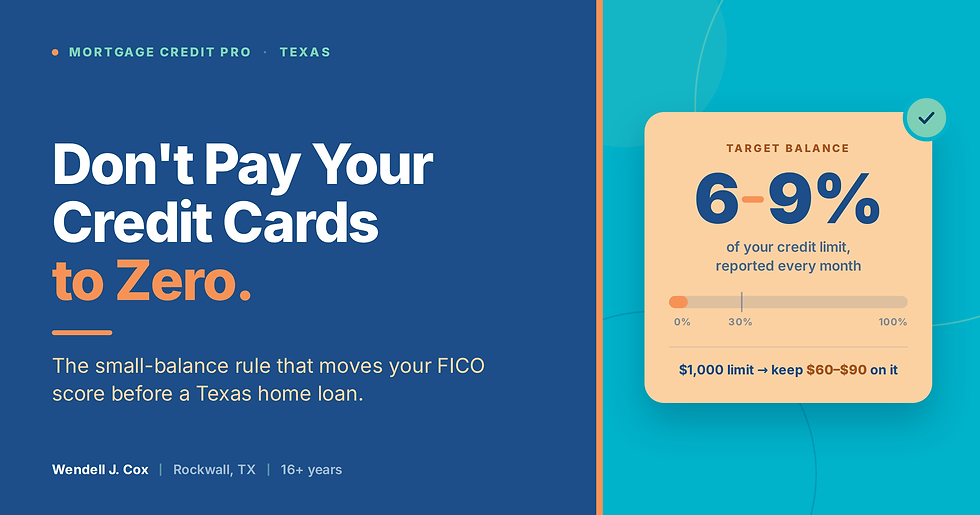
Utilization under control. Balances in the single digits as a percentage of your limit score far better than 50% or 80%. Amounts owed is 30% of your FICO and it's the fastest lever you have — and the reported balance is what counts, so timing matters.
Clean, seasoned payment history. 35% of the score. "Time since delinquency is too recent" is one of the most common reason codes I see on files that should have been approved.
No open disputes at application. A disputed derogatory gets excluded from the scoring model, and the automated system won't accept findings built on an excluded tradeline. Dispute work happens before you apply — sequencing your loan officer will thank us for.
That last point is the difference between credit repair for mortgage approval and generic credit repair. A credit repair company that doesn't understand underwriting can leave your file in a state that actively blocks your loan. We know which components a report needs for lender approval because we've spent 16+ years on both sides of the closing table.
Your plan of action goes out within 3–5 business days of enrolling, and once it's implemented most clients see score movement inside 30 days.
Denied with a "good" score? We'll tell you exactly what's missing. Start your free 30-minute credit consultation →
2026 changed the scoring rules, quietly
In April 2026, FHFA and HUD approved VantageScore 4.0 and FICO 10T alongside Classic FICO for mortgage underwriting. Both read 24 months of trended data instead of a single snapshot, and both can use rent and utility history that Classic FICO ignores.
Practical takeaway: direction now matters as much as position. A borrower paying balances down month over month reads better than one revolving the same balance for two years at the same score. Adoption is uneven across lenders — which is one more reason to have someone in your corner who tracks this for a living.
What credit repair costs and why ours is different
Most credit repair companies charge an average of $300 per deleted item. The average credit report has around 11 items that could come off. Do that math and a "cheap" service becomes $3,000 fast, and you're rationing which items you can afford to remove.
We built Mortgage Credit Pro the opposite way: unlimited disputes and deletions for a fraction of that cost. No per-item pricing, no choosing which negative you can afford to fight this month.
On timeline, I won't sell you a 30-day miracle. Simple files run 30–60 days. Most of our mortgage-bound clients land in the 3–6 month window — one Houston client had his score up over 100 points in four months and called the pricing very reasonable. Complex files with identity theft or multiple charge-offs can run 6–12 months. Bureaus get 30 days to investigate each dispute; that's federal law, not a sales pitch.
Now the other side of the ledger. In Texas, TDHCA and TSAHC both offer up to 5% of the loan amount in down payment assistance — and both gate at a 620 minimum score. A few months of credit work can unlock $15,000 you literally cannot access below that threshold, plus a lower rate and lower mortgage insurance for the next 30 years. That's the credit repair investment return nobody puts on a flyer.
Unlimited disputes and deletions, one flat program. See what your report actually needs →
Serving Texas — and speaking your language
We're based in Rockwall and work with buyers in Dallas, Houston, Austin, San Antonio, Arlington and El Paso — and clients in all 50 states.
Many of the families we work with handle money conversations in Spanish. Credit is confusing enough in your first language, so we walk through the report and the mortgage timeline in whichever language the household actually thinks in. Hablamos Español. Reparación de crédito en español, para familias en Texas que quieren comprar casa. Agenda tu consulta gratis →

Comments