.avif)
Pay Off Credit Cards Before Buying a House in Texas?
I get this question almost every week, and it always arrives the same way. Someone sits down, we go through their report, and they say: Wendell, just tell me to pay these cards to zero and be done with it.
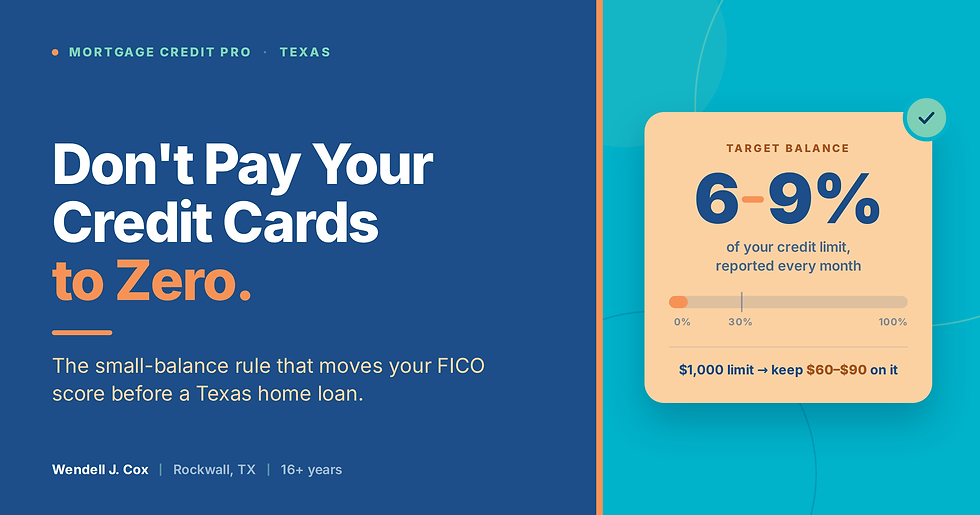
Here is the short answer. If you are trying to pay off credit cards before buying a house, taking every card to a zero balance is not what gets you approved fastest. A small balance that reports each month — we target roughly 6% to 9% of the limit — is what I see move a FICO score quickest for someone chasing a home loan. Zero on everything can leave you flat at the exact moment you need points.
That sounds backwards to most people. Let me explain it the way I'd explain it sitting across from you.
What Happens When You Pay Off Credit Cards Before Buying a House
Nobody arrives at the zero-balance idea by accident. You were told your whole life that debt is bad and carrying a balance is expensive. Both true, and I will not argue with either.
But carrying debt and reporting a balance are two different things, and confusing them quietly costs Texas buyers points every month.
Your score is not a judgment on what you owe. It is a prediction, and the model is answering one question: how does this person handle revolving credit when they have access to it? A card sitting at zero answers that with silence. A card showing a small balance, handled every month, answers it with evidence.
What the FICO Model Is Actually Measuring
Almost everything in the mortgage world still runs on FICO. FHA — where a lot of credit-challenged Texas buyers land — uses Classic FICO, and FHA lenders cannot use the newer models until January 1, 2027, optional even then. VA and USDA run on FICO too. So here at Mortgage Credit Pro, we build every file to FICO.
The model weighs roughly like this:
35% — payment history. On-time payments, lates, collections, charge-offs.
30% — amounts owed. Where balances live, and the piece that moves fastest.
20% — credit mix. Three to four cards reporting, plus an installment loan.
The rest comes from new credit and length of history.
On that 30%, FICO's own education material says it plainly: "In some cases, a low credit utilization ratio will have a more positive impact on your FICO Scores than not using any of your available credit at all." (myFICO on amounts owed)
Read that again. It is the whole article in one sentence. Low is not zero, and low beats zero.
The 6% to 9% Target We Use
You will read "keep it under 30%" everywhere online. Thirty percent is a ceiling, not a target — the line where things start getting ugly, not where scores climb.
Files start moving when the reported balance sits between 6% and 9% of the limit. On a $1,000 limit, that is $60 to $90 showing when the card reports. On a $3,000 limit, $180 to $270.
I'll be straight about where that comes from: FICO does not publish a magic percentage. Six to nine is what sixteen years of real files taught me, and it is what we build toward in the Lender Approval Program. Results vary.
Three to Four Cards, Every Month
One card doing this is a data point. Three or four doing it every month is a pattern, and patterns are what the model rewards. It also feeds the credit mix side of the equation.
It is why I tell people not to close old cards — see why closing a credit card stops people from qualifying and the three-to-four card strategy.
The Part Almost Nobody Explains: Your Statement Closing Date
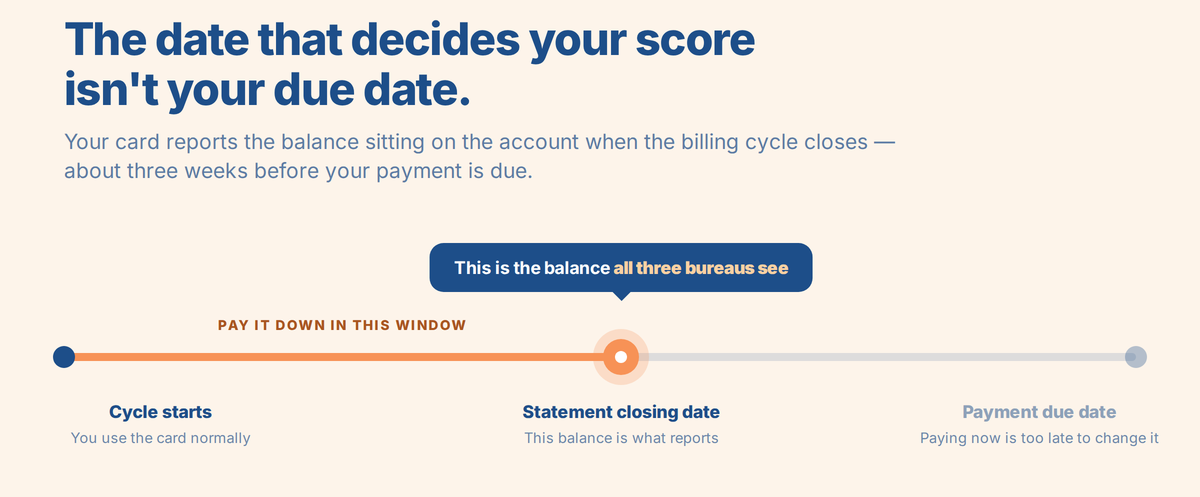
Here is where most advice falls apart, and where a file that moves separates from one that sits.
Your card issuer does not report on the day you pay. It reports the balance sitting on the account when your statement closing date hits — the end of the billing cycle, not your payment due date. Two different dates, usually about three weeks apart.
So you can pay in full every month, never pay a dime of interest, and still have 60% utilization reporting to Equifax, Experian and TransUnion, because you charged $600 on a $1,000 limit and the statement closed before your payment posted. That buyer walks into a lender's office sure they have perfect habits, and the tri-merge comes back thirty or forty points low.
The fix is timing, not discipline. The extra payment goes in before the statement closes, so the balance that reports is the 6% to 9% number. You pay the rest after. Same money, same month, no interest — different score.
What It Looks Like on a $1,000 Limit

What you do | What reports | Utilization | What the underwriter sees |
Charge $600, pay in full after the statement closes | $600 | 60% | Heavy revolving use |
Pay the card to zero and stop using it | $0 | 0% | No recent revolving activity |
Charge normally, pay down to $75 before the closing date | $75 | 7.5% | Active, controlled, low risk |
Roughly the same spending, three very different files. One is set up to pass.
Why the Timing Matters More When You're Buying in Texas
A mortgage credit pull is a snapshot. Whatever reported last is what gets underwritten, and you do not get to explain it away.
That matters here because Texas down payment assistance has a hard credit floor. TSAHC states you need a 620 credit score for its Homes for Texas Heroes and Home Sweet Texas programs, and TDHCA's My First Texas Home runs on the same kind of gate — the difference between buying this year and waiting two more. We cover them in our Texas down payment assistance guide.

A buyer sitting at 611 because three cards reported maxed in the wrong month does not have bad credit. That is bad sequencing, and it is fixable.
We work with buyers across the state: credit repair in Rockwall, Dallas, Houston, San Antonio, Arlington, Austin and El Paso. Hablamos Español — our whole process runs in Spanish for the families who need it that way.
What This Work Actually Involves
I just handed you the cleanest, fastest piece of the puzzle. Balances are the one part of a file that moves in a single reporting cycle. The rest is not that simple.
Most files that reach my desk are not one problem. There is a collection that has to be worked directly with the agency — a negotiation, not a form. A charge-off reporting the wrong date. An inaccurate late the bureau marks "verified," which means the next round needs a different argument, and every round is another 30-day reinvestigation cycle.

And it all has to happen in the right order. Balance work in the wrong month, a new card at the wrong time, an installment loan two weeks before application — any of those drops a score right when you need it highest. With a purchase contract and a closing date on the calendar, sequencing becomes the whole job.
That is the Lender Approval Program: every component of your file reading correctly to FICO, in the right order, before the lender pulls.
What It Costs to Get This Wrong
Most credit repair companies charge an average of $300 per deleted item, and the average report has around eleven items that could come off. Run that math and you see why people quit halfway. We do it differently — unlimited disputes and deletions for a fraction of that.
But the real cost is not the fee. It is the rate. A buyer who closes at 620 and one who closes at 700 on the same Texas house pay a different number every month for thirty years — and a buyer who misses the 620 gate does not buy at all.
The Bottom Line
Do not pay your cards to zero and wait. Keep three to four cards reporting a small, controlled balance, get the payment in before the statement closes, and let the model see what it is built to reward.
To find out where your file stands, take the free 30-minute consultation. We review your credit profile, identify the items holding your score down, determine a plan of action, and set your goal — in writing in three to five business days. In most files we see movement inside the first 30 days.
We are at 709 West Rusk St. in Rockwall, Texas — 469-746-3232. Sixteen-plus years in credit repair and mortgage, trusted by lenders and REALTORS® across Texas.
If you have been told your credit is too far gone to buy a house, I have heard that sentence from people who closed eight months later. Find out what is on your report before you decide what is possible.
Frequently Asked Questions
Does paying off a credit card completely hurt your credit score? Not the way a late payment does, but it can leave points on the table. FICO's guidance is that low utilization can have a more positive impact than using none of your credit at all. If every card reports zero, the model has little recent revolving behavior to score.
How much should I leave on my credit card before applying for a mortgage in Texas? We target a reported balance of roughly 6% to 9% of the limit on three to four cards — $60 to $90 on a $1,000 limit. Your exact target depends on what else is on your file, which is what the consultation is for.
What credit score do I need to buy a house in Texas? It depends on the loan. FHA reaches lower than conventional; VA has lender overlays. The number that matters most to Texas first-time buyers is 620, the minimum for TSAHC down payment assistance and the TDHCA programs with it. More in what credit score you need to buy a house.
How long before a paid-down balance shows up on my credit report? Generally one billing cycle. Your issuer reports after the statement closes, so a balance brought down before that date lands on the next report, often within 30 days. If you are under contract, your loan officer can sometimes request a rapid rescore.
Watch: Why I Tell Clients Not to Pay Their Cards to Zero
I break it down in under a minute — watch Wendell explain the small-balance strategy.
More on the FICO components, credit tiers and Texas buyer programs on the channel.


Comments