.avif)
Don't Close That Credit Card: The Mistake That Stops People From Qualifying for a Mortgage
By Wendell Cox — Founder, Mortgage Credit Pro

I hear it almost every week: "Oh, I've got this credit card I don't use anymore — I'm going to close it." It sounds like discipline, but it's one of the fastest ways to drop your score right when you need it most to qualify for mortgage approval. A big part of my job isn't fixing the past; it's stopping good people from making a brand-new mistake today because nobody explained the rules.
This guide is designed for anyone looking into credit repair Texas residents can rely on, showing you exactly how to protect your score and avoid common pitfalls.
Why Closing Credit Cards Backfires
People usually close cards to clean things up, avoid interest, or cut unused lines. But the scoring system doesn't reward having fewer accounts; it rewards having available credit that you don't use.
Here is what actually happens when you cancel a card:
•Your utilization spikes instantly: Credit utilization (how much you owe versus your total limit) makes up 30% of your FICO score. If you close a card with a $0 balance, your total available credit shrinks. This pushes your utilization percentage higher, immediately dropping your score.
•Your credit history ages toward erasure: Closed accounts in good standing stay on your report for 10 years. After that, they drop off, causing your average account age—which accounts for 15% of your score—to take a hit right before you apply.
•Your credit mix shrinks: Closing revolving accounts leaves you with only installment loans, hurting the "credit mix" factor (10% of your score).
•You keep the bad history: If the card has late payments, closing it doesn't erase them. You lose the available limit but keep the negative marks.
The Silent Risk: The Bank Closes It For You
Many people just tuck unused cards in a drawer. Banks routinely close inactive accounts because they don't make money on them—sometimes after just six months of no activity, and without warning. Losing $5,000 of available credit the day your lender pulls your report can cost you a great mortgage rate.
The Fix: Keep the Card Alive (For Free)
The simplest way to protect your score is to take that unused card, put a small, stable subscription on it (like Netflix), and set the account to autopay the full balance every month.
This strategy is the foundation of successful credit repair for mortgage approval. It:
•Keeps the account active and prevents the bank from closing it.
•Maintains your total credit limit, keeping utilization low.
•Builds positive payment history every month.
•Costs you zero interest because the balance is paid in full.
Why This Matters More in 2026
Mortgage scoring is shifting from a single "snapshot" to trended data (used by FICO Score 10T and VantageScore 4.0). Lenders now look at up to 24 months of behavior. The model rewards the "transactor" (who pays in full) over the "revolver" (who carries debt). You can no longer fix your profile in 60 days; you must prepare a year or two ahead.
The Real Cost of a Score Drop
Lenders price loans based on score bands (e.g., 620, 680, 740). Falling below a threshold due to a closed card can mean a higher interest rate for 30 years, more expensive mortgage insurance, or losing access to certain programs. The difference can be tens of thousands of dollars over the life of the loan, making a credit score increase one of the most valuable financial moves you can make.
How Credit Repair Actually Works
If you need to fix your credit for a mortgage, keep these facts in mind:
•Timelines: By law, credit bureaus have 30-45 days to investigate a dispute. Realistic timelines for how long does credit repair take is usually 3 to 12 months depending on complexity.
•Costs: Legitimate services usually charge a monthly fee or a setup fee. By law (CROA), they cannot charge you before performing the work. If you are wondering about the credit repair cost, most credit repair company options range from $50 to $150 a month.
•Strategy vs. DIY: You can try DIY credit repair, but a mortgage-focused credit repair service provides strategy—knowing which items to challenge to hit the exact score threshold you need. The credit repair investment return is huge when it secures a better mortgage rate.
The Golden Rule Before Applying
Do not close any credit cards until after you close on your house.
Put a small subscription on inactive cards with autopay set to the full balance.
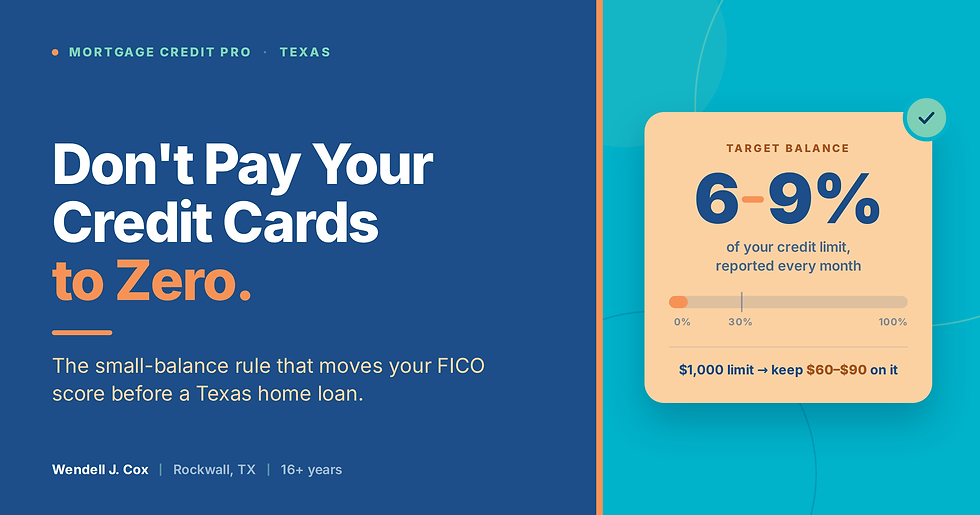
Keep utilization low (under 30%, ideally under 10%) and pay the full statement balance.
Do not open new credit or take out financing during the process.
Start preparing months in advance, not weeks.
Frequently Asked Questions
Does closing a credit card hurt my chances to qualify for a mortgage?
Yes, usually immediately. It reduces your available credit, raising your utilization ratio and potentially dropping you below a pricing threshold.
Most people don't lose points because they're irresponsible; they lose them because of decisions nobody explained in time. At Mortgage Credit Pro, we specialize in preparing the credit of people who are about to buy a home. If you're planning to buy a home in the next 24 months, now is the moment to start. We offer specialized credit repair services tailored to Texas residents.

Comments